Spacecraft status NOMINAL Mission clock 00:00:00 UTC Distance from Earth 148.3 million km Geomagnetic watch ACTIVE

Research programme

Science

The mission exists for an operational reason, but the measurements it produces answer questions that have been open since the corona was first photographed.

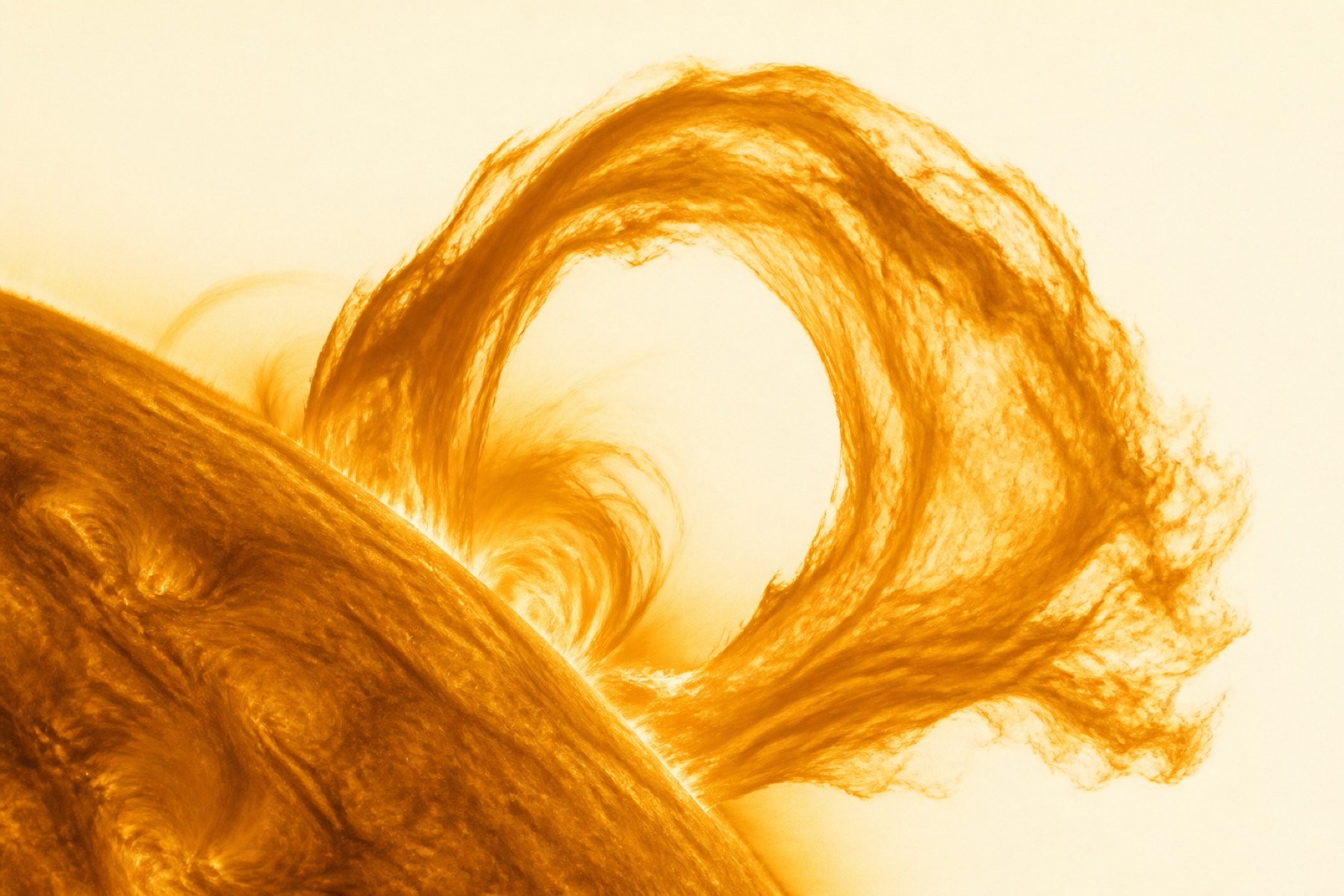
A solar prominence arcing from the limb of the Sun
Fig. 05 — Eruptive prominence, extreme ultraviolet channel, false colour

Three questions

What we are
trying to learn

Each has an operational consequence, which is why a forecasting mission can afford to ask them.

Q1

Why does the corona deflect eruptions?

Coronal mass ejections rarely travel straight. Seen from the side, the deflection can be measured directly rather than reconstructed from a halo, which is the single largest source of forecast error today.

Q2

How does the far side prepare a storm?

Active regions grow for days before rotating into view. Magnetography from L5 turns that blind week into a catalogue with numbers attached.

Q3

What heats the solar wind on the way?

Plasma leaving the Sun arrives hotter than adiabatic expansion allows. In-situ instruments at L5 sample a stream that near-Earth monitors will meet five days later.

Data policy

Open, immediately

No proprietary period, no embargo, no instrument team privilege. Calibrated products reach the public archive within one hour of downlink.

Daily volume
41
gigabytes downlinked
Latency to archive
58
minutes median
Product levels
4
raw to science-ready
Licence
CC
attribution only

Consequences on the ground

Who is affected
by a solar storm

A severe event is not an abstraction. It is induced current in transformers, degraded positioning, and radiation dose at 11 000 metres.

Power grids

Geomagnetically induced currents saturate transformer cores. Operators need eight hours to reconfigure a network safely.

Aviation

Polar routes lose high-frequency communication and accumulate radiation dose. Rerouting a long-haul schedule takes twelve hours.

Satellites

Drag increases, single-event upsets multiply. Fleet operators put spacecraft into safe mode and postpone manoeuvres.

Positioning

Ionospheric disturbance degrades precision navigation, which surveying, agriculture and rail signalling all depend on.